How We Used Competitor Gaps to Steal a Local 3-Pack Spot: A 2026 Strategy
In the world of local search, the Google Maps 3-Pack is the ultimate prize. It is the digital equivalent of a storefront on Main Street with a line out the door. But here is the cold, hard truth that most agencies won’t tell you: the 3-Pack is a zero-sum game. There are only three spots. For you to move in, someone else must move out. This isn’t just about “optimizing” your profile; it is about strategic displacement.
As the Head of Local SEO at GMB Ranking Restored, I’ve spent years analyzing why some businesses stay stuck at position #4 while others dominate. The secret isn’t just having a “good” profile; it’s about finding the “gaps” in your competitors’ armor. When we take on a new client for our google maps ranking service, we don’t just look at their business – we perform a forensic audit of the current winners to see exactly where they are failing.
According to Search Engine Journal, performing a deep local competitor analysis provides a “huge advantage in the SERPs,” yet many business owners ignore it, focusing only on their own data. By identifying technical oversights, category mismatches, and review stagnation in your rivals, you can systematically “steal” their ranking. This guide outlines the exact framework I, Shahid Anwar, use to turn Google Maps visibility into real phone calls and leads by exploiting competitor gaps.
Identifying Your “Search” Competitors vs. “Business” Rivals
One of the most common mistakes I see is businesses trying to outrank the wrong people. Your “business” rivals – the shop down the street that does great work – might not be your “search” rivals. In the 3-Pack, your real competition is whoever currently occupies the top three spots for your primary keywords.
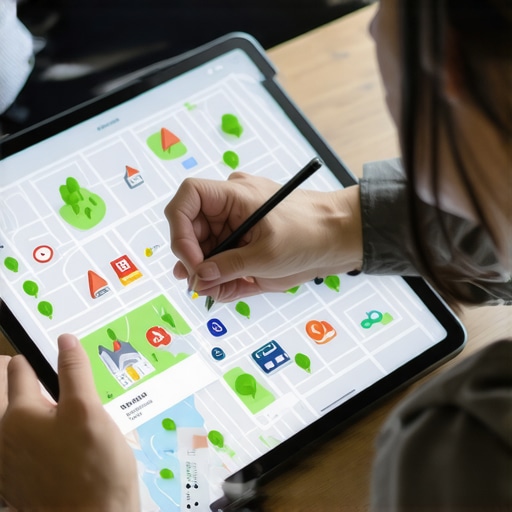
To identify these gaps, you cannot rely on a single search from your office desk. Proximity is a major ranking factor, and the map looks different every 500 yards. We use local seo tools to generate a geo-grid map. This allows us to see exactly where a competitor’s dominance begins to fade. If a competitor is ranking #1 in the north of the city but drops to #5 in the south, that is a geographic gap waiting to be exploited.
Using this local seo tool, we can visualize the “heat map” of the 3-Pack. For example, when we developed A Practical Local SEO Plan for Roofers to Win the 3-Pack, we discovered that while the top competitor had a massive review count, their ranking dropped off sharply just two miles from their warehouse. By focusing on hyper-local signals in the surrounding neighborhoods, our client was able to “encircle” and eventually displace them in the most profitable zip codes.
The GBP Audit Gap: Categories and Attributes
The foundation of any Ultimate Guide to Local SEO Rebuild is the Google Business Profile (GBP) audit. Most businesses set their categories once and never look at them again. This is a massive opportunity for you.
Following the SEOSiteCheckup 15-item checklist for competitor analysis, we look specifically at the Primary and Secondary categories. Often, a competitor is ranking because they were the first in the area to claim their profile, but they are using outdated or overly broad categories. We frequently find that picking the wrong business category is silently killing search reach for established players. If your competitor is listed as a “General Contractor” but 80% of their business is “Kitchen Remodeling,” and you optimize specifically for the latter, you have a technical gap you can exploit.
Beyond categories, look at Attributes. Are they using the “Online Appointments” or “On-site Services” tags? Are they identifying as women-owned or veteran-owned if applicable? Google uses these attributes to match specific user intent. If a competitor has left these blank, filling yours out gives Google a reason to prefer your “entity” over theirs for nuanced searches.
The Review & Reputation Gap (Beyond the Star Rating)
A common pain point I hear is: “I have 200 reviews and a 4.9 rating, but my competitor has 150 reviews and a 4.5 rating, yet they are #1. Why?”
The gap here isn’t the quantity; it’s the velocity and diversity. Google’s algorithm prioritizes recency (velocity) and the keywords contained within those reviews. If your competitor hasn’t received a new review in three weeks, they have a “stagnation gap.” By implementing an automated review acquisition strategy, you can signal to Google that your business is currently more relevant to the local community.
Furthermore, we look at “Keyword Diversity.” Do the reviews mention specific services and locations? We found that improving lead quality by switching to neighborhood keywords in our review responses and encouraging customers to mention their specific area (e.g., “The best plumber in Lincoln Park”) creates a massive relevancy gap that a generic competitor cannot bridge. If your competitor isn’t responding to reviews, or is giving generic “Thanks!” replies, you can outperform them by using your responses to reinforce your service area and expertise.
The Citation & NAP Consistency Gap
While many claim citations are a “legacy” SEO factor, they remain a critical “trust” signal in 2026. The gap here is often found in the “messiness” of a competitor’s data. Using a google business profile audit tool, we look for Name, Address, and Phone (NAP) inconsistencies in the competitor’s profile across the web.
If a competitor moved offices two years ago and still has 40% of their citations pointing to the old address, their “trust score” in the eyes of Google is compromised. This is your opening. By ensuring your NAP is 100% consistent across Tier 1 directories (Yelp, Bing, Apple Maps) and Tier 2 local niche directories, you present a “cleaner” entity to the algorithm.
Don’t stop at structured citations. The real “gold mine” in 2026 is unstructured citations. These are mentions of your business on local news sites, community blogs, or neighborhood association pages. If you can get a mention on a local “Best of” list that your competitor isn’t on, you are creating a localized authority gap that is very difficult for them to close without significant PR effort.
Exploiting Content Gaps for 2026 AI Search
As we move into 2026, Google’s Search Generative Experience (SGE) and AI Overviews are changing how the 3-Pack is populated. Google is no longer just looking for keywords; it is looking for Entities. If Google’s AI can’t clearly distinguish your business from another nearby, you may suffer from “Entity Overlap.”
We solve this by identifying “Content Gaps.” What questions are customers asking that your competitors aren’t answering? By using the Google Business Profile Q&A section and your website’s local landing pages, you can feed the AI the data it needs to recommend you. If you are struggling with this, check out our guide on 3 GMB Ranking Recovery Fixes for Entity Overlap.
To rank google business profile assets in the AI era, you must provide structured data (Schema.org) that goes beyond the basics. Most competitors stop at “LocalBusiness” schema. You should be using “Service” schema, “FAQ” schema, and “Review” schema to give the AI a rich map of what your business actually does. This technical depth creates a “sophistication gap” that helps you jump over older, less technically-sound profiles.
The Technical “Coup de Grâce”: Signals and Proximity
The final move to steal a 3-Pack spot involves tightening your geo-fence through google business profile optimization. One of the most frustrating issues for business owners is when their pin only shows up when they are literally standing in their office. This is often a result of weak “Local Justifications.”
Have you noticed the small snippets in the 3-Pack that say “Their website mentions [keyword]”? Those are justifications. If your competitor lacks these, it’s a massive gap. You can trigger these by ensuring your linked website has dedicated pages for every service and every neighborhood you serve. This expands your “relevancy radius,” allowing you to show up further away from your physical location than your competitors.
Additionally, address mobile-specific visibility. If your website is slow or has poor Core Web Vitals, Google may hide your map pin on mobile searches to ensure a good user experience. We have identified 7 specific fixes for a map pin that only appears on mobile searches that can help you reclaim lost territory. By optimizing for mobile-first indexing, you exploit the technical debt of older competitors who haven’t updated their site infrastructure in years.
Conclusion & Action Plan
Stealing a 3-Pack spot isn’t about luck; it’s about identifying where the current leaders are lazy. Whether it’s a category mismatch, stagnant review velocity, or a lack of AI-ready entity signals, every gap is an opportunity for you to rank higher on google maps.
The strategy of “turning visibility into real phone calls” requires a relentless focus on these details. If you’re ready to stop guessing and start dominating, use SEO Viper Tools to run your first gap analysis today. Alternatively, if you want a team of experts to handle the “theft” for you, our google maps ranking service is designed to find those gaps and fill them with your business.