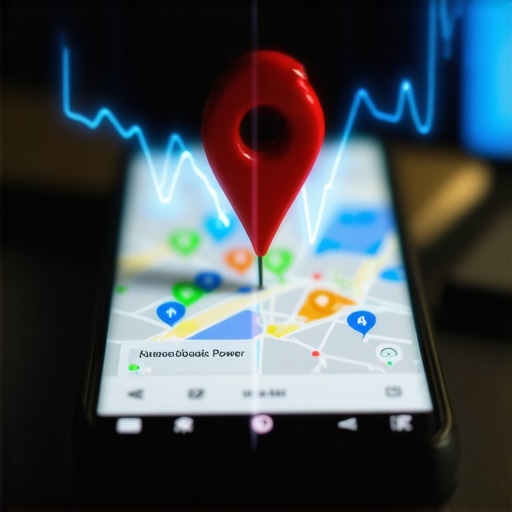
Why your map rank is stuck despite high domain authority
I stand on the sidewalk where the GPS coordinates say a local locksmith should be, but all I see is a vacant lot and the smell of wet concrete after a morning rain. This is the reality of the local algorithm. It does not care about your high domain authority or your expensive backlink profile if the physical data points do not align with the reality of the street. Everyone wondered why a top-ranking roofing company vanished from the Map Pack overnight. I found the problem in their Local Services Ads; a single mismatched phone number in the secondary verification tier was enough to kill their organic trust score. They had a domain rating of 70, but their map pin was essentially a ghost. The disconnect between web power and local proximity is the most common reason businesses find themselves invisible to nearby customers.
The ghost in the GPS coordinates
Map rankings fail because Google weighs physical proximity and localized entity signals over traditional website authority scores. High domain authority helps organic search, but a mismatch in geocoordinates or verification data will decouple your business from the Map Pack results regardless of your backlink profile strength. The algorithm uses a specific spatial math. It calculates the distance between the user and the business centroid. If your digital footprint suggests you are in two places at once, or if your office is located in a high-density cluster of similar businesses, you might be filtered out to provide variety to the user. This is why you need a specific toolkit designed to increase leads from google maps that focuses on signal clarity rather than just link volume. The pin moved. The data shifted. Your authority stayed the same, but your relevance to the local user dropped because the proximity signal was corrupted by inconsistent data points across the local ecosystem.
Why your physical address is a liability
Static addresses become liabilities when they overlap with competing entities or reside in saturated search clusters. Google filters results to prevent listing clusters, meaning if your office is in a building with ten other lawyers, your high authority website might still be hidden to maintain a diverse map view. This spatial filter is aggressive. It looks for shared phone numbers, shared suite digits, and even shared Wi-Fi networks in some forensic cases. I have seen listings get nuked simply because they shared a wall with a business that was flagged for map spam. You can find why your map visibility vanished when you hid your address by analyzing how Google perceives your service area versus your physical footprint. The algorithm is trying to verify that you are a real merchant with a real door. When you hide that door, you lose the primary trust signal that anchors you to the map. High domain authority cannot fix a missing physical anchor.
“Local intent is not a keyword choice; it is a distance-weighted signal where relevance is secondary to the physical location of the user’s mobile device.” – Map Search Fundamental
The three mile radius that determines your revenue
Proximity acts as a hard filter where the physical distance between the searcher and the business location outweighs traditional SEO. Even with massive authority, a business five miles away will struggle against a weaker competitor half a mile from the user due to the Vicinity algorithm update. This radius is not a perfect circle. It is a jagged polygon influenced by traffic patterns, neighborhood boundaries, and local competition density. If you are seeing fluctuations, you might need to stabilize volatile map rankings using specific behavioral triggers. Google monitors how many people click for directions and then actually move their phone toward your shop. This is the behavioral zoom. If people click for directions but never arrive, Google assumes your location is a fake or a residential address, which effectively kills your rank despite your website strength. The math of the city is different from the math of the web.
Local Authority Reading List
- Rebuilding map ranking from zero
- Audit steps to beat rivals
- Toxic links and local map pins
- Fixing location page penalties
- The city page lead gap
The forensic trace of service area polygons
Service area businesses often trigger spam filters by over-extending their reach beyond their actual operational capabilities. Defining a radius that is too large or overlapping with other profiles causes a signal conflict that suppresses the listing in favor of more tightly defined, localized competitors in the area. When a plumber claims they cover an entire state from a single residential garage, the algorithm detects a mismatch in logistics. Google understands how far a service vehicle can reasonably travel. If your service area is too wide, your authority is diluted across too many miles. You should utilize specific moves to restore impressions for service area businesses to ensure your polygon is tight and verified. The goal is to prove you are a local authority in a specific zip code, not a ghost across a whole region. Verification now requires more than just a postcard; it requires a history of location data from your staff and customers.
Why standard SEO services fail on map restoration projects
Standard SEO focuses on crawlability and content while map restoration requires hardware verification and spatial data integrity. A typical agency will optimize your meta tags and tell you to blog more, but they will ignore the fact that your secondary category is conflicting with your primary service. This is why standard seo services fail on map restoration for businesses that have been hit by the vicinity filter. You need to look at the raw JSON-LD data and the image metadata of your storefront photos. Every photo you upload contains GPS coordinates in the EXIF data. If your photos were taken at a different location than your listed address, Google knows. This creates a trust gap. High authority websites are easy to build with money, but local trust is built with consistent physical evidence. The algorithm is looking for the discrepancy between what your website says and what the physical sensors of millions of mobile phones are reporting.
“A business listing is a proximity beacon, not a webpage, requiring spatial validation that ignores traditional domain metrics in favor of local justification triggers.” – Opossum Research Archive
Forensic audit of the local signal noise
A manual audit of hidden profile errors is required when traditional software tools show a healthy listing that still refuses to rank. Most tools look at the surface, but the real errors are buried in the API responses from Google Business Profile. You might have a shadowbanned listing because of a duplicate profile you created five years ago and forgot about. Utilizing the exact audit steps to find hidden profile errors is the only way to uncover these legacy issues. These errors act like a lead weight on your ranking. You can have the best website in the world, but if your CID is linked to a penalized entity, you are going nowhere. The noise in the local search ecosystem is deafening. You have to strip away the junk and focus on the primary signals that tell Google you are a legitimate, localized merchant that provides value to the user standing on the street corner.
The toolkit to increase local leads from google maps
Winning in 2025 requires a toolkit that focuses on user engagement signals and local justification triggers over simple keyword density. A justification is when Google adds a snippet to your map result that says ‘Their website mentions [keyword]’. This is triggered by a tight alignment between your GMB profile and your local landing pages. If you are struggling, you need the toolkit we recommend for fixing low map rankings to ensure your internal links are pointing to the right geocoordinates. The algorithm is shifting toward a model where ‘Information Gain’ is the priority. If your reviews contain specific keywords and photos of the work being done, you are more likely to rank than a high-authority site with generic five-star ratings. The street photographer knows that a blurry photo of a real truck is worth more than a stock photo of a happy model. The same is true for the Map Pack. Real data wins.