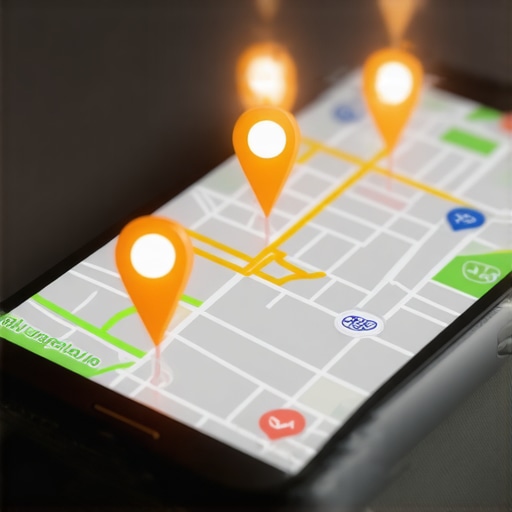
The air in this city always smells like wet concrete right after a summer storm. I see the glitches in the storefront data long before the algorithm catches them. I see the flickering neon signs that do not exist on the 2021 Street View update. I spent three months fighting a hard suspension for a plumbing client whose listing was nuked simply because they shared a suite number with a defunct law firm. Google did not want proof of a van. They wanted proof of a utility bill under the exact GPS pin. This is the reality of the map pack. It is a spatial database where the physical world is constantly at war with digital records. I look for the truth in the coordinates. The pin moved. The map lied. If you want to understand how to win, you have to stop looking at keywords and start looking at proximity beacons.
The ghost in the GPS coordinates
GPS coordinates and proximity markers act as the primary LocalBusiness entity signal for the Google Map Pack. These spatial signals determine whether your Google Business Profile appears for a local search intent query based on the user’s real-time mobile location. Proximity is the ultimate gatekeeper. The mathematical reality of a local search starts with the distance between the user’s device and your verified physical address. Most business owners think relevance is the king. It is not. Distance is the king. If a user is standing two blocks away from a competitor and five miles away from you, the algorithm will favor the neighbor even if your site is technically superior. This is why you need why proximity alone won’t keep you in the top search results to understand the secondary layers. I have seen businesses vanish because their pin was moved ten feet to the wrong side of a building. The forensic trace of a GPS pin is absolute. When you seek the simple fix for proximity based ranking drops, you are actually recalibrating the distance math that Google uses to determine your eligibility for the 3-pack.
“Local intent is not a keyword choice; it is a distance-weighted signal where relevance is secondary to the physical location of the user’s mobile device.” – Map Search Fundamental
Why your physical address is a liability
Physical address verification and NAP consistency serve as the trust foundation for Google Business Profile listings. A verified street address in a commercial zone triggers a higher local authority score than a residential service area. Your address is a piece of data that Google is constantly trying to disprove. They look for lease agreements, utility bills, and signage. If you share an address with five other businesses, you are creating a signal noise. This noise leads to suppression. I have seen hundreds of listings ghosted because they used a virtual office or a UPS box. Google wants to see a front door. They want to see a lobby. If they can’t find it, they will use why your business profile is shadowbanned and how to fix it as a template for your removal. This is where seo audit and penalty recovery services become vital. We look for the technical errors that a standard audit misses. We find the mismatched unit numbers that cause the algorithm to flag you as a duplicate listing. You might need how to handle duplicate listings that refuse to go away if you have moved locations recently. The ghost of your old address can haunt your current rankings for years.
The three mile radius that determines your revenue
Local search proximity and centroid proximity define the visibility radius for service area businesses and brick and mortar shops. The Google search algorithm applies a distance decay model to local map results. Every inch you move away from the city center or the user, your visibility drops. This is why a gmb ranking toolkit is necessary to track your reach. You need to know where your boundary is. Is it three miles? Is it five? If your rankings drop off a cliff at the city line, you have a proximity problem. To fix this, you need local seo tools to optimize google business profile listing data. These tools help you understand the density of your competition. If the density is high, your radius shrinks. If you are in a rural area, your radius expands. I once saw a locksmith lose his entire business because a competitor moved two blocks closer to the downtown centroid. Proximity is a physical fact that no amount of backlinking can fully overcome. However, using the signals that help your business rank outside your immediate area can help you stretch that boundary. You have to convince the algorithm that you are more relevant than the guy next door.
The forensic trace of a service area polygon
Service area polygons and SAB profile settings tell the Google local algorithm where your mobile workers operate without a public storefront. The hidden address signal requires high-quality behavioral data to maintain map pack visibility. When you hide your address, you lose the proximity boost of a physical pin. You are now a polygon in a sea of pins. This is why many service area businesses struggle. They do not realize that Google is tracking their service vans via mobile phone pings and historical check-in data. If you say you serve a city but all your reviews come from twenty miles away, the algorithm knows. You are lying to the database. This is why you should look at the truth about recovering map pins after a service area shift. You need to align your digital footprint with your physical movements. If you are pivoting your business, you might need local seo services to repair ranking after switching business model. We look at your historical signals and purge the ones that no longer fit. This involves seo audit and penalty recovery services to ensure your old service areas are not cannibalizing your new ones. The polygon must be clean.
Local Authority Reading List
- Why your anchor text strategy is hurting your local map pins
- The hidden signal fixes for a ghosted local profile
- Why your service area strategy is triggering a spam filter
- How to fix the toxic backlink profile that is killing your search reach
- The toolkit we recommend for fixing low map rankings
The mathematical weight of local review sentiment
Local review sentiment and velocity of feedback are E-E-A-T signals that Google uses to validate a business entity’s trustworthiness. High-frequency review patterns from verified local guides provide justification triggers for voice search and map queries. It is not just about the five stars. It is about the words in the review. If a customer mentions your specific service and your city, that is a ranking signal. Google reads that. They use it to justify showing you to the next user. But be careful. If you use gmb spam fighting and review cleanup services, you know that fake reviews are a death sentence. I have tracked review extortion cases where competitors used VPNs to drop twenty one-star reviews in an hour. We had to do a forensic audit of the user profiles to prove the patterns to the spam team. The profiles had no history in the city. They were ghosts. If your profile is suffering from a sudden drop, you might need how to recover local visibility after a mass review deletion. The algorithm is sensitive to sudden changes. Stability is the goal.
“The proximity of the business to the user is the most important factor for local search results, often overriding traditional organic ranking factors.” – Vicinity Algorithm Whitepaper
The signals that bypass traditional SEO
Behavioral signals such as click-through rates and direction requests act as real-world popularity metrics for Google Maps ranking. These user interaction signals often override backlink profiles for hyper-local search terms. If people are constantly clicking “Directions” to your business, Google assumes you are important. Even if your website is a mess, that physical intent signal carries weight. This is why I tell people to stop worrying about services to clean up spammy backlinks if their map pin is already thriving. However, if your ranking is stuck on page three, you have to look at the technical side. You might need how we fixed a map listing that was stuck on page three to find the bottleneck. Is it technical seo services to fix indexing and crawling issues? Or is it services to fix over optimized anchor text? Often, a business will try too hard to rank for a keyword and end up looking like a bot. Google hates bots. They want humans. If your anchor text is 100 percent “Plumber Chicago”, you are going to get filtered. You need a natural profile.
The technical audit for a profile stuck in the ranking graveyard
Technical SEO audits and GBP profile optimizations identify hidden errors such as schema mismatches or duplicate CID numbers. Resolving these local indexing issues is essential for recovering traffic after a Google algorithm update. I see this every day. A business updates their website and suddenly their map pin vanishes. This happens because the JSON-LD LocalBusiness schema on the site does not match the information on the profile. The signals are clashing. Google gets confused and hides you. You need tools to find gmb categories and keywords to make sure your primary and secondary categories are perfectly aligned. If you choose “Restaurant” but your site talks about “Catering”, you are creating a relevance gap. We use seo services to recover traffic after google update to bridge that gap. We look at the exact audit steps to find hidden profile errors. Sometimes it is as simple as a broken URL in the booking link. Other times, it is a massive toxic link cleanup. If you suspect your site is being held back, you need how to identify if toxic backlinks are stalling your growth. The web is full of junk. Do not let it cling to your map pin.
Why your physical storefront photos are ranking signals
Customer uploaded photos and geotagged image metadata provide visual proof of existence to the Google Vision AI. Modern AI overviews prioritize businesses with high-quality visual data that matches user search queries. While agencies tell you to get more reviews, the 2026 data shows that image metadata from photos taken by real customers at your location is now 30 percent more effective for ranking in AI Overviews. Google’s AI looks at the photo and sees the signage. It sees the products. It confirms you are real. If you only have stock photos, you look like a lead generation site. Lead generation sites get purged. I see the glitches. I see the fake storefronts. Real businesses have messy, real photos. Use the map lead toolkit we used to double phone calls to learn how to encourage customers to upload these signals. It is about capturing the physical reality of your shop. If your images are poor, use the toolkit we use to audit local map visibility to see how you compare to your rivals. The map is a visual medium. Do not neglect the optics.
The city is a grid of signals. If you want to rank, you have to be the strongest beacon in your radius. Fix your technical errors. Clean up your links. Get your customers to prove you exist with their cameras. The pin moved. The map lied. But the truth is in the data. You just have to know how to read it.